Understanding PPE in LED Grow Lights
LED grow light efficiency plays a major role in determining how effectively a fixture converts electrical power into usable photons. The most important measurement for this performance is PPE (Photosynthetic Photon Efficacy), expressed in µmol/J. Unlike wattage—which only indicates power consumption—PPE tells growers how much usable light a fixture actually produces per watt.
A higher PPE means the LED grow light generates more photosynthetically active photons using the same amount of energy, making it more cost-efficient, heat-efficient, and better suited for large-scale indoor environments.
Because PPE is independent of total wattage, it allows growers to compare LED fixtures in a meaningful, apples-to-apples way across different brands, sizes, and form factors.
1. What PPE Really Measures—and Why It Matters
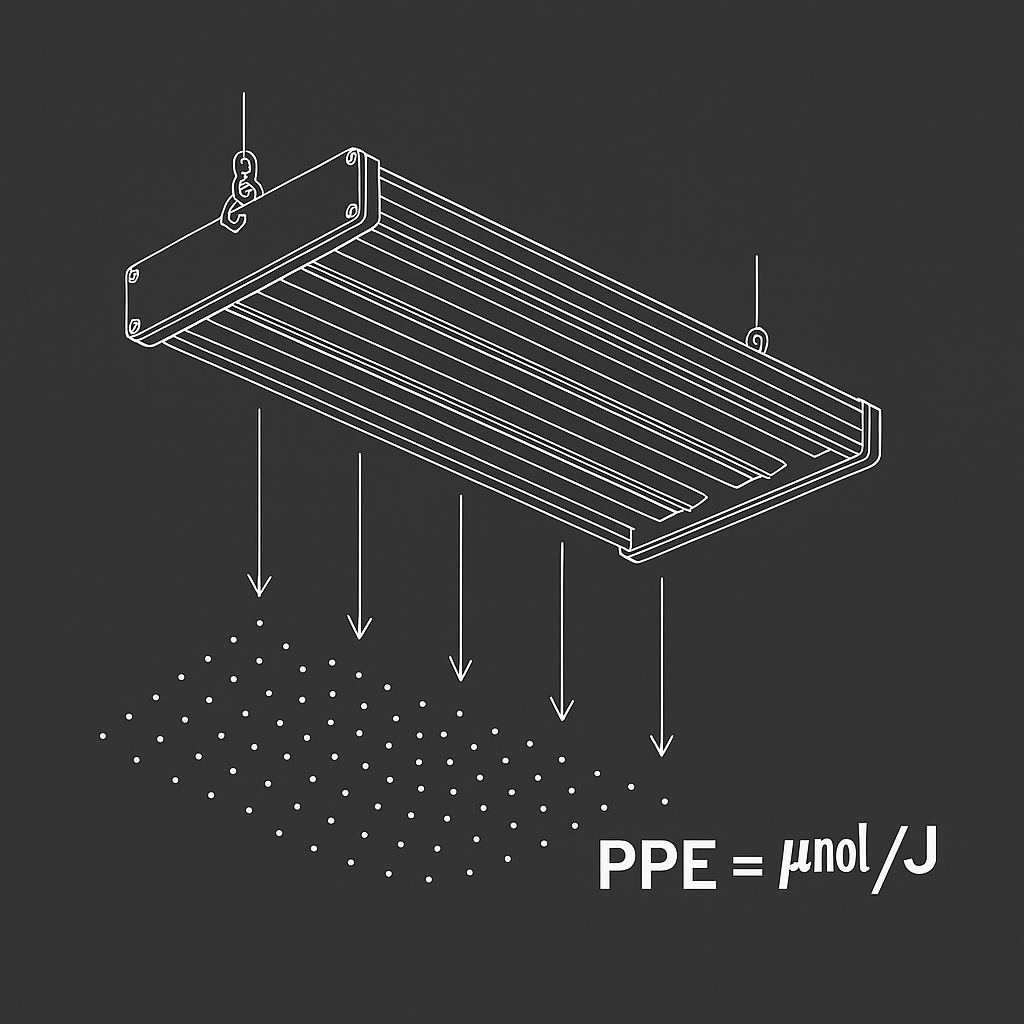
PPE measures how many µmol (micromoles) of usable light a fixture produces for each joule of power consumed. In practical terms, it answers the question:
“How efficiently does this LED convert electricity into usable plant light?”
- A fixture rated at 2.7 µmol/J is significantly more efficient than one rated at 2.3 µmol/J.
- Over time, this difference results in lower electrical costs and more usable light per square foot.
- Facilities running dozens or hundreds of fixtures can save thousands of dollars annually by selecting high-PPE models.
2. PPE vs PPFD: Understanding the Difference
PPE and PPFD are among the most misunderstood metrics in LED grow lighting. While they are related, they measure completely different things.
PPE = Fixture efficiency
How well the fixture converts electricity into photons.
PPFD = Delivered light intensity
How many photons actually reach the plant at canopy level.
A high-PPE fixture is good, but growers also need uniform PPFD distribution across the entire canopy—not just a high center reading. An LED can have excellent PPE but still perform poorly if its optics and bar spacing create uneven photon coverage.
3. How LED Chips & Drivers Influence Efficiency
PPE performance is heavily shaped by two core components of every LED grow light: the diodes and the driver. Even when two fixtures share the same wattage, differences in these components can lead to dramatically different photon efficiencies.
High-quality diodes = higher PPE
LED chips (diodes) determine how effectively electrical current becomes photons. Premium diode architectures are engineered to minimize energy loss and generate tighter wavelength distributions. This results in:
- More photons produced per watt
- Greater spectral accuracy
- Improved long-term stability
- Less heat per unit of light output
Because diodes operate billions of cycles over their lifetime, diode quality has a long-term impact on PPE retention and spectral consistency.
Driver efficiency is just as important
Many growers overlook the LED driver, but it can account for major efficiency losses. Drivers convert AC wall power into low-voltage DC current for the LEDs. Poor driver design causes:
- Electrical waste (lost watts)
- Increased fixture heat
- Reduced PPE under high load
- Voltage instability across light bars
High-efficiency drivers maintain consistent current, minimize heat generation, and help fixtures preserve their PPE ratings over time. Together, diodes and drivers form the “engine” of PPE performance.
4. Heat, Thermal Behavior & PPE Stability
Heat is the natural enemy of LED efficiency. As diode junction temperatures rise, PPE decreases because electrical resistance increases. A fixture may be rated at 2.8 µmol/J in laboratory conditions but drop to 2.6 or lower during real-world operation if thermal performance is poor.
Cooler LEDs are always more efficient
Modern high-performance fixtures use advanced thermal engineering to keep diodes cool:
- Thick aluminum bars that dissipate heat faster
- Wider bar spacing to improve airflow
- Ribbed or finned heatsinks to increase surface area
- Passive thermal pathways that stabilize junction temperatures
Growers in multi-layer or rack-based environments need to pay even more attention to cooling, because airflow restrictions naturally increase fixture temperature. Higher heat → lower PPE → higher energy cost. Good thermal control prevents that downward spiral.
5. Dimming Performance & Efficiency Drop-Off
Many facilities dim their LED grow lights during early growth stages, during transplanting, or to manage heat. But not all fixtures maintain PPE when dimmed. Some LEDs lose efficiency because their spectral distribution shifts or because drivers do not regulate current optimally at lower power levels.
High-quality systems preserve spectral integrity and PPE even when running at 40–60% power. That’s important because growers rely on dimming for:
- Managing heat in vertical stacking systems
- Reducing light intensity for young strains
- Lowering energy use during off-peak production cycles
- Preventing light stress during sensitive transitions
If PPE collapses when dimming, PPFD mapping becomes unreliable and energy efficiency falls. Choosing fixtures with dimming-stability is essential for predictable results.
6. How to Choose a High-Efficiency LED Grow Light
While PPE receives a lot of attention, it is only one part of a truly efficient LED grow light. A well-designed fixture balances photon efficacy, PPFD uniformity, thermal stability, spectrum integrity, and long-term durability. When selecting a high-efficiency LED system, growers should look beyond the marketing numbers and examine how the fixture performs in real-world conditions.
Key criteria for choosing an efficient LED grow light:
- PPE of 2.6–3.0+ µmol/J for modern, high-performance fixtures.
- High uniformity mapping rather than just a high PPFD center value.
- Stable spectral output when dimmed (no color shift).
- High-quality diodes with proven long-term stability.
- Efficient LED drivers to prevent electrical and thermal loss.
- Strong passive cooling design with thick bars or finned heatsinks.
- Even bar spacing for consistent canopy coverage.
- Compatibility with under-canopy lighting for deeper penetration—such as dedicated systems from under-canopy LED providers.
Fixtures that meet these criteria deliver more usable photons per watt and maintain their performance over many cycles, ultimately reducing operational costs while improving yield stability across strains.
7. Efficiency in Multi-Layer & Vertical Rack Environments
Vertical farms and multilayer rack systems place additional demands on fixture efficiency. Because spacing between shelves is tight, heat accumulates faster and airflow becomes limited. This makes PPE stability under thermal stress especially important.
Growers operating vertical setups should prioritize fixtures that include:
- Cooler operating temperatures to prevent efficiency drop.
- Consistent spectrum output at reduced heights.
- Uniform PPFD distribution across the entire rack level.
- Low-profile bar designs to maximize usable space.
High-efficiency LEDs help maintain predictable performance in these constrained environments, reducing energy waste and preventing lower canopy decline.
8. Why PPE Alone Is Not Enough
Although PPE is a critical metric, growers should avoid selecting fixtures based solely on efficacy numbers. A system with high PPE but poor optical design or poor uniformity can underperform compared to a slightly lower-PPE fixture with excellent distribution.
Real efficiency comes from a combination of:
- PPE (photon efficacy)
- PPFD uniformity
- Spectrum stability
- Thermal management
- Dimming accuracy
- Architectural design
The best fixtures treat PPE as a foundation—not the entire story.
9. How PPE Interacts With Spectrum, Uniformity & Real-World Output
While PPE is primarily a measure of how efficiently electrical power becomes photons, its true value emerges only when combined with spectrum design and uniform PPFD delivery. Many growers evaluate these elements separately, but in real-world environments they operate as a single system. A fixture may offer high PPE, but if its spectrum lacks balance or its light distribution is uneven, the practical benefit of high efficacy becomes noticeably reduced.
Spectrum determines which wavelengths are produced, while PPE determines how efficiently those wavelengths are generated. For example, fixtures with strong red and far-red output may demonstrate very high PPE numbers, since red photons require less energy to produce. However, overly red-weighted spectrums can reduce structural stability or cause excessive elongation in certain strains. A more balanced spectrum—incorporating blue, white, red, far-red, and optional UV-A—may produce slightly lower PPE but deliver significantly better canopy performance. This is why comparing fixtures solely by µmol/J without examining their spectral composition can lead to misleading conclusions.
Uniformity is another factor that directly impacts the real-world effectiveness of PPE. Even if a fixture produces photons efficiently, poor optical distribution can lead to hotspots and low-intensity zones across the canopy. These inconsistencies cause plants to grow unevenly, forcing growers to raise fixtures higher or dim them more than necessary. In such cases, operators inadvertently reduce the effective PPFD and DLI delivered to the canopy, rendering high PPE meaningless. A fixture with slightly lower PPE but superior uniformity often outperforms a high-efficacy model when evaluated over multiple production cycles.
Environmental conditions also interact with PPE more strongly than most growers realize. Heat, humidity, and airflow shape how efficiently diodes operate. An LED that performs at 2.8 µmol/J in a well-ventilated test room may drop to 2.5 µmol/J when installed in a warm grow environment with restricted vertical clearance. This is especially common in vertical farms, where airflow pathways are tighter and thermal buildup occurs more quickly. Optimizing environmental conditions frequently restores lost PPE and stabilizes long-term performance.
Finally, fixture maintenance and cleaning play an important role in preserving PPE over time. Dust, moisture, and residue on LED bars or optics can block as much as 5–10% of usable photons, effectively reducing real-world efficacy even though the electrical efficiency of the diodes remains unchanged. Regular cleaning schedules, proper IP-rated fixtures, and high-quality coatings help ensure that PPE performance remains stable throughout the fixture’s lifespan.
Understanding these interactions allows growers to view PPE not as an isolated specification, but as part of a larger ecosystem involving spectrum design, optical engineering, environmental control, and long-term maintenance. When evaluated holistically, PPE becomes a powerful predictor of both performance consistency and operational efficiency.
Conclusion
PPE is one of the most important performance indicators for modern LED grow lights. It defines how efficiently electrical power becomes usable photons and directly influences operating costs, fixture longevity, and overall lighting performance. By understanding PPE, evaluating diode and driver quality, managing heat, and reviewing real-world PPFD performance, growers can choose lighting systems that deliver consistent, efficient results across many cycles.
For growers seeking a deeper overview of LED grow light performance and available fixture types, explore the complete guide here: LED Grow Lights Overview.