



PPFD uniformity is one of the most Proven ways to improve crop consistency, reduce weak zones, and make better use of every square foot in a controlled environment. In vertical farms, propagation rooms, and indoor cultivation spaces, uneven light distribution often leads to uneven growth, inconsistent morphology, wasted energy, and avoidable production losses. The good news is that most uniformity problems can be corrected with smarter fixture selection, better spacing, more deliberate mounting strategies, and a lighting plan designed around the crop rather than just the room.
At WegrowPros, we work with growers who need more than just high output. They need repeatable performance, predictable coverage, and lighting layouts that actually fit their racks, benches, crop stages, and production goals. Whether you are upgrading a single flowering room or planning a multi-tier facility, improving PPFD uniformity is one of the highest-value lighting decisions you can make.
Why PPFD Uniformity Matters in Indoor Cultivation
PPFD measures the amount of photosynthetically active photons that reach the crop canopy each second. But raw intensity alone does not tell the full story. A room can show strong average PPFD while still performing poorly if that light is concentrated in hot spots and weak edges.
When growers improve PPFD uniformity, they usually see better canopy consistency, more even plant development, fewer quality differences between the center and perimeter of the growing area, and smoother irrigation and climate management. Uniform lighting also makes cultivation data more trustworthy because plant-to-plant performance is less distorted by lighting variation.
PPFD Uniformity Formula and Practical Meaning
A common way to evaluate a PPFD uniformity formula is by comparing minimum PPFD to average PPFD across the target area. A higher ratio means the weakest points in the canopy are closer to the average, which generally indicates better light balance. Growers may also compare minimum-to-maximum spread or use grid-based light mapping to identify problem areas.
In practice, the goal is simple: reduce extremes. You want fewer overlit patches, fewer underlit corners, and better consistency across the productive footprint.
PPFD Uniformity Standard by Crop and Application
There is no single universal PPFD uniformity standard that applies to every facility, because propagation, vegetative growth, flowering, tissue culture, and leafy greens all have different intensity targets and space constraints. Still, the same principle applies everywhere: the tighter the light distribution across the canopy, the easier it becomes to maintain consistent crop quality and predictable results.
1. Choose Fixtures Designed for Coverage, Not Just Output
Many lighting problems begin when growers compare fixtures based only on total wattage or headline PPFD numbers. A powerful fixture with poor optical distribution can create aggressive center intensity and weak perimeter performance. That may look impressive in a product snapshot, but it can create real cultivation issues once installed.
For broad, even coverage, it is often better to use fixtures designed for distribution across the intended footprint. This is especially important in vertical farming and multi-layer installations, where every inch of mounting height matters. Products such as the Phoenix dual-channel LED grow light and the Dragrow dual-channel LED grow light are worth considering when growers need high efficiency with better control over spectral strategy and coverage planning.
2. Match Fixture Spacing to the Real Canopy Area
One of the most common mistakes in indoor cultivation is using fixture spacing based on room dimensions instead of active canopy dimensions. Aisles, wall offsets, bench gaps, structural obstacles, and rack geometry all affect how light actually reaches the plants.
If you want stronger PPFD uniformity, build your layout around the crop footprint. That means mapping the real production area, checking edge overlap, and avoiding oversized gaps between fixtures. In many cases, slightly tighter spacing with lower drive intensity produces better canopy balance than wider spacing with higher intensity.
Why Edge Overlap Improves PPFD Uniformity
Uniformity usually improves when fixtures overlap at their edges in a controlled way. This softens the transition between one light zone and the next, reducing sharp drops in photon density. Instead of thinking only about how much light one fixture produces, think about how the fixtures work together as a system.
3. Optimize Mounting Height Before Changing the Whole Layout
Growers sometimes assume they need entirely new fixtures when the first improvement should be mounting height. Raising or lowering a fixture changes both intensity concentration and spread. A fixture mounted too low can create bright centers and dark borders. Mounted too high, it may lose efficiency at canopy level or spill light into non-productive space.
The right height depends on fixture design, beam distribution, crop stage, and the room’s physical constraints. In low-clearance environments, this becomes even more important. Facilities using multi-tier systems should pay close attention to fixture thickness, thermal management, and the space available between the light source and the canopy.
For growers building or upgrading rack systems, it helps to review both fixture and infrastructure options together. The LED grow lights category and the broader grow lights, racks, and benches section can help align lighting decisions with physical growing layouts.
4. Use Dimming Strategically Across Zones
Dimming is not only for reducing energy use. It is also a practical tool for improving PPFD uniformity. In some rooms, the center zone may receive more overlap than the perimeter, or one side of the room may reflect more light because of wall finish, rack position, or equipment layout. In these cases, zone-based dimming can help correct imbalances without rebuilding the entire system.
When Zone Control Makes Sense
Zone control is especially useful in rooms with:
- Irregular footprints
- Different crop stages in adjacent sections
- Mixed bench widths
- Partial retrofits using old and new fixtures together
- Perimeter rows that develop differently from center rows
Dual-channel and controllable fixtures can add flexibility here, especially when growers want to tune both intensity and spectral output around specific production goals.
5. Reduce Reflective and Structural Distortions
Even a good fixture layout can produce poor uniformity when the room itself interferes with light distribution. Posts, irrigation lines, low-hanging equipment, fan assemblies, wall proximity, and reflective hot spots can all distort the map.
Structural Issues That Affect Light Uniformity
Check for these common problems:
- Fixtures mounted too close to walls
- Uneven bench heights
- Rack uprights blocking distribution paths
- Mixed fixture models in the same zone
- Unbalanced reflectance from surfaces and curtains
Growers focused on lower-canopy penetration or layered crop development may also want to review under-canopy lighting strategies. For more ideas in that area, see Under Canopy Grow Lighting.
6. Map the Canopy Instead of Guessing
Many uniformity issues stay hidden because the room is judged by appearance rather than data. Human eyes are not reliable tools for measuring photon distribution. A room can look bright and still perform unevenly.
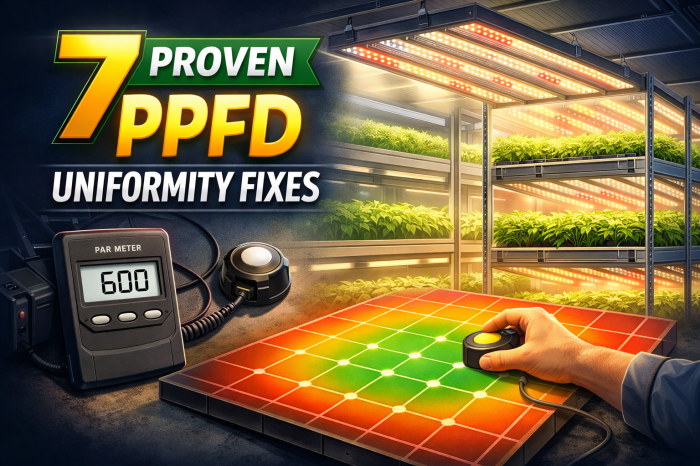
The best approach is to take a proper grid of light readings at canopy level. Measure the center, corners, edges, and in-between points across the active growing area. Then compare the weakest points to the average. This process makes it much easier to see whether the real problem is spacing, height, optics, room geometry, or simply overdriving the system.
How Often Should You Recheck PPFD Uniformity?
Recheck uniformity whenever you:
- Change fixture type
- Adjust mounting height
- Reconfigure benches or racks
- Switch crop type or canopy density
- Expand the room or add new zones
7. Plan for the Crop’s Full Lifecycle, Not One Snapshot
A lighting layout that looks acceptable during propagation may underperform in late vegetative growth or flowering. As canopies fill in, plant architecture changes, shading patterns shift, and the consequences of poor PPFD uniformity become more visible.
Uniformity Is a Lifecycle Decision
That is why the best lighting plans consider:
- Crop stage transitions
- Target DLI strategy
- Canopy depth and density
- Rack-level airflow and heat movement
- Future expansion and rebate planning
If you are also evaluating fixture efficiency, project timing, and incentive opportunities, it may help to review current planning resources at Grow Lights Rebate while comparing technical and operational goals.
How WegrowPros Helps Improve PPFD Uniformity
At WegrowPros, our focus is not just selling fixtures. It is helping growers select the right lighting system for the application, the footprint, and the production target. That means looking at room dimensions, crop type, mounting constraints, fixture profile, spectral control, and how the complete environment will perform once installed.
Solutions for Vertical Farms, Benches, and Controlled Environments
Growers working with multi-level systems often need slim fixtures, strong efficacy, better heat management, and predictable distribution across narrow or repeated footprints. That is where application-specific products and layout planning matter most. Instead of chasing the highest isolated number, the better strategy is usually to build a repeatable system with balanced coverage and controllable output.
Why Balanced Light Beats Peak Hot Spots
The strongest crop rooms are rarely the ones with the highest center reading. They are the ones with fewer weak zones, less waste, and more consistency across the working canopy. Balanced light supports better scheduling, better labor efficiency, and more reliable quality control.
Final Thoughts on PPFD Uniformity
PPFD uniformity is not a small technical detail. It is a core performance factor that shapes crop consistency, lighting efficiency, and operational predictability. If your room has strong averages but uneven results, the issue may not be total output at all. It may be distribution.
By improving fixture selection, spacing, mounting height, dimming strategy, and canopy mapping, growers can correct major lighting imbalances and build a more productive indoor environment. And when those decisions are made early, they often prevent far more expensive corrections later.
If you need help selecting fixtures, evaluating coverage, or building a lighting plan for racks, benches, or full indoor facilities, contact us for a static and swift result.
FAQ: PPFD Uniformity in Grow Rooms
What is good PPFD uniformity for a grow room?
Good PPFD uniformity means the weakest areas of the canopy stay reasonably close to the average intensity, reducing underlit zones and making crop development more consistent.
Why does PPFD uniformity matter more than peak intensity?
Peak intensity only describes the brightest points. Uniformity tells you how evenly the crop receives usable light across the productive area, which is often more important for consistency.
Can fixture spacing improve PPFD uniformity?
Yes. Smarter fixture spacing is one of the most effective ways to reduce hot spots and weak edges while improving whole-canopy light balance.
Does mounting height affect PPFD uniformity?
Absolutely. Mounting height changes the spread pattern and intensity concentration, so even small adjustments can significantly improve canopy coverage.
Should I measure PPFD uniformity regularly?
Yes. Rechecking uniformity after layout changes, crop changes, or equipment upgrades helps maintain predictable performance over time.