



Good LED grow lights are only as effective as the way they’re sized and laid out. This guide walks through seven smart steps to size LED grow lights for any room so PPFD isn’t too low in key zones, too high in others, or wasted on areas outside the real canopy footprint. Smart LED grow light sizing starts with PPFD and area, not just watts per square foot.
The goal is simple: give each stage of growth the right PPFD, maintain uniform coverage across the canopy, and avoid paying for photons that never land where they should. The steps below walk through a practical way to size LED grow lights for veg and flower, then translate that into fixture count and layout that fits any room shape.
Why Proper LED Grow Light Sizing Matters
Under-lit rooms leave yield on the table. Portions of the canopy never reach the PPFD and DLI targets needed for full expression, so development stays soft and harvest weight drops. Over-lit rooms drive up power and HVAC load, increase leaf stress, and still may not fix weak areas if coverage and uniformity are off.
Instead of chasing a single “watts per square foot” number, it’s more reliable to plan from PPFD and DLI targets, then use fixture efficacy (PPE) to estimate total wattage. If those ideas need a refresher, the guides on PPFD & DLI for LED Grow Lights and LED Grow Light Efficiency & PPE are a good base to build on.
7 Steps to Size LED Grow Lights for Any Room
Step 1 – Define the Real Canopy Footprint
Start with the productive canopy area, not the outside dimensions of the room. Measure the trays, tables, or benches where plants actually sit. For a single-tier room this might be a cluster of 4×8 or 5×10 tables; in vertical systems it includes every level of each rack.
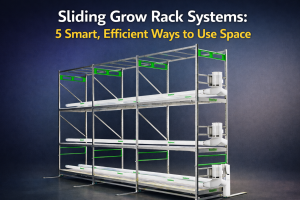
Ignore storage corners, doors, and workstations that never hold plants. Those areas do not need full PPFD coverage and shouldn’t drive the sizing math. Concepts from modern grow table layouts and vertical growing systems translate directly here: count true production surface, not empty perimeter space.
For quick planning, convert the total canopy footprint into square feet or square meters. This becomes the base for all later PPFD and PPF decisions.
Step 2 – Set PPFD Targets for Veg and Flower
Next, decide how much light each stage should receive. Different crops and strain types tolerate different intensities, but most high-value indoor programs fall into these ranges:
- Propagation / early veg: roughly 150–300 µmol/m²/s
- Veg structure building: roughly 300–600 µmol/m²/s
- Early generative / transition: roughly 600–800 µmol/m²/s
- Full generative / flower push: roughly 800–1000+ µmol/m²/s, depending on strain and environment
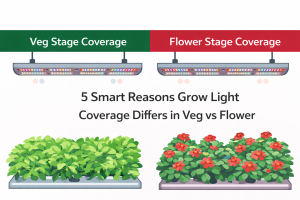
Rooms that run a dedicated veg cycle can be sized with lower PPFD and wider coverage, while dedicated flower rooms usually trade some footprint for higher intensity. The deeper dive in Vegetative Stage Lighting and the main Benefits of LED Grow Lights article gives more context on how those targets feel in practice.
Choose a realistic target, not the highest number ever seen on a spec sheet. The right PPFD target always matches climate capacity (VPD, CO₂, temperature) and strain tolerance, not just ambition.
Step 3 – Convert PPFD & Area into Total PPF
Once canopy area and PPFD targets are clear, it’s time to estimate the total photon output the room needs. Conceptually, the calculation looks like this:
Total PPF (µmol/s) ≈ Target PPFD (µmol/m²/s) × Canopy Area (m²)
For example, a 40 m² flower canopy at 900 µmol/m²/s requires roughly 36,000 µmol/s of total PPF at the canopy surface. This number is a starting point—actual design will account for fixture layout, reflectivity, and losses—but it frames how much output the LED grid must provide.
If you plan to run different PPFD levels in veg and flower under the same roof, work out PPF targets for each room independently rather than trying to average them together. The PAR & DLI planning guide is useful here when thinking about daily light load instead of just instant readings.
Step 4 – Use Fixture PPE to Estimate Total Wattage
With a PPF target in hand, fixture efficacy (PPE) turns photon requirements into real-world wattage. A simple rule of thumb:
Total Wattage ≈ Total PPF ÷ Fixture PPE
If the room needs 36,000 µmol/s and you select LEDs with a PPE around 2.8 µmol/J, the working wattage estimate lands near 12,900 watts. That wattage will be distributed across multiple fixtures, but the total tells you what to expect for power and HVAC planning.
Higher PPE means fewer watts are needed to hit the same PPFD target. The article on PPE and fixture efficiency goes deeper into why some LED grow lights deliver more usable photons per watt than others and why “watts per square foot” by itself is no longer enough for serious planning.
Step 5 – Decide Fixture Count, Size & Layout
Now it’s time to turn total wattage and PPF into actual fixture count. This is where the footprint and format of the LEDs matter. Few high-power fixtures may hit the right total PPF but leave edges soft, while more slim-bar fixtures can smooth out coverage and improve light uniformity.
For rectangular canopies, many growers prefer fixtures that roughly match common tray sizes (4×4, 4×8, 5×5) to keep layout repetitive. The LED Grow Lights overview and the spectrum-focused article on spectrum-optimized fixtures show how different bar arrangements, beam angles, and channel options fit above standard footprints.
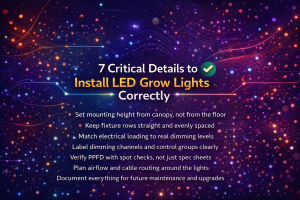
At this stage, rough out a grid that keeps spacing consistent in both directions and leaves enough room for maintenance aisles, drains, and airflow paths.
Step 6 – Check Uniformity, Mounting Height & PPFD Maps
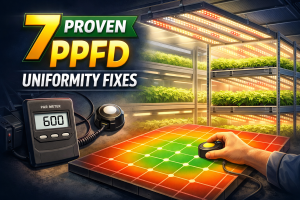
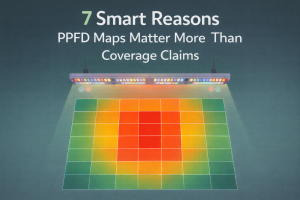
A room can meet its average PPFD target and still struggle if light uniformity is poor. Hotspots, dark corners, and uneven bar spacing create local PPFD extremes that plants respond to very differently. Before the room is filled, it pays to validate the layout with PPFD maps at the planned mounting height.
Small adjustments—moving fixtures a few inches, changing mounting height, or tightening row spacing—can raise the lowest PPFD readings without overshooting the center. The detailed uniformity discussion in light uniformity & mounting height and the comparison of PPFD maps vs coverage claims in PPFD mapping strategy are helpful references while fine-tuning this step.
In denser canopies or vertical racks, PPFD maps often reveal that the lower structure is significantly under-lit even when the top looks perfect. In those cases, purpose-built under-canopy fixtures—such as the solutions highlighted at UnderCanopyGrowLighting.com and the article on under-canopy lighting in horticulture—can bring lower levels back into balance.
Step 7 – Fine-Tune with Dimming & Spectrum Control
Once the physical layout is dialed in, dimming and spectrum control handle the last layer of refinement. Young plants rarely need full intensity, and running fixtures at lower power during early veg can reduce stress and extend driver life. Later, intensity can be ramped up as canopy fills in and the environment is ready to handle the extra load.
Multi-channel fixtures with adjustable spectrum give even more flexibility. Cooler, blue-leaning blends help keep structure tight in veg, while additional red or far-red can be introduced later to support generative push and canopy penetration. Practical approaches to dimming schedules and spectrum steering are outlined in Mastering Dimming for Indoor Grow Lights and LED Grow Light Spectrum Insights.
Design Notes & Common Sizing Mistakes
Relying Only on Watts per Square Foot
Legacy rules like “30–50 watts per square foot” were built around older technologies and do not account for PPE, spectrum, or uniformity. Two fixtures with identical wattage can deliver very different PPFD patterns and very different grams per square foot. Modern sizing should always start with PPFD and PPE rather than a single watt-density number.
Ignoring HVAC, Dehumidification and VPD
More light means more heat and more transpiration. As PPFD and total wattage climb, HVAC and dehumidification must keep pace or the room will drift out of ideal VPD ranges. Before finalizing fixture count, it’s worth cross-checking the plan against environmental capacity and the troubleshooting cues described in Experiencing Grow Issues? Check VPD.
Not Planning for Future Fixture Upgrades
Buildings and racking often outlast the first generation of LEDs. When mapping a room, it pays to leave enough flexibility in power distribution, mounting rails, and aisle spacing to support higher-efficacy fixtures later. The switch path from legacy lighting to modern LEDs discussed in HPS to LED Grow Lights Complete Guide shows how much easier upgrades become when basic spacing and infrastructure are planned early.
Conclusion
Smart LED grow light sizing is more than picking a fixture and filling the ceiling until it “looks bright.” Starting from canopy footprint, PPFD targets, and fixture PPE makes it much easier to hit yield goals without overshooting power and HVAC capacity. From there, fixture layout, uniformity, PPFD maps, and dimming strategy refine the room into a predictable, repeatable environment.
When rooms are planned this way, the question “How many LED grow lights do I need?” turns into a clearer formula instead of guesswork. For growers reviewing hardware options or planning a new build, the LED Grow Lights pillar guide ties these sizing concepts back to specific fixture types, spectrum options, and application examples.