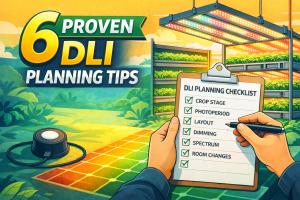

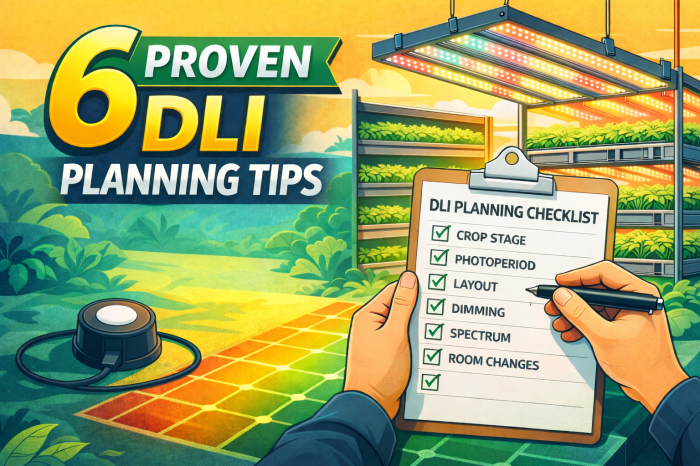


DLI planning is one of the most Proven ways to improve crop consistency, control energy use, and build a lighting strategy that actually matches plant needs across propagation, vegetative growth, and finishing. Many indoor growers focus only on fixture wattage or peak PPFD, but fdaily light integral gives a more complete view of how much usable light the crop receives over the full photoperiod. When DLI planning is handled correctly, growers can make better decisions about fixture selection, dimming, mounting height, rack design, and production timing.
At Grow Pros Solutions, we help growers look beyond isolated light numbers and build systems that support real cultivation goals. Whether the application involves vertical farming, indoor propagation, mother stock, vegetative rooms, or flowering environments, DLI should be part of the lighting conversation from the start rather than treated as an afterthought.
Why DLI Planning Matters in Indoor Cultivation
Daily light integral measures the total amount of photosynthetically active photons delivered to the crop over the course of a day. That makes it especially useful for indoor growers, because it connects intensity and photoperiod into one practical planning framework. A room with moderate PPFD over a longer day can sometimes deliver a similar DLI to a room with higher PPFD over a shorter day, but the crop response, heat load, and operating strategy may still be very different.
Good DLI planning helps growers avoid both under-lighting and over-lighting. It also supports better fixture sizing, more consistent scheduling, and more predictable plant development from one zone to the next.
DLI Planning vs. PPFD: Why Both Matter
PPFD shows how much photosynthetic light reaches the canopy each second, while DLI reflects the total amount delivered each day. Both are important. PPFD helps you understand instant canopy intensity, while DLI helps you understand cumulative light exposure. The strongest cultivation strategy usually uses both metrics together rather than treating them as separate topics.
1. Start DLI Planning with the Crop Stage
The first rule of effective DLI planning is simple: start with the crop stage, not the fixture catalog. Seedlings, clones, vegetative crops, flowering plants, and leafy greens do not all need the same daily light target. If you choose fixtures before defining the crop’s actual light needs, you increase the odds of wasting energy, creating unnecessary stress, or building a room that is difficult to manage later.
Why Crop Stage Changes DLI Targets
Propagation zones often require gentler light levels and careful environmental stability, while later-stage crops may benefit from higher daily totals if water, nutrients, CO2 strategy, and temperature are also aligned. This is one reason lighting plans should be integrated with the full production model rather than created in isolation.
2. Build DLI Planning Around Photoperiod, Not Intensity Alone
One of the most common mistakes in indoor cultivation is chasing higher PPFD without considering how long the lights stay on. DLI planning works best when growers evaluate intensity and photoperiod together. A longer photoperiod can raise total daily photons without requiring extreme canopy intensity, which may be useful in some vegetative or leafy green environments. In other cases, production targets, crop physiology, or room constraints may favor a different balance.
This is why fixture design and controllability matter so much. Products such as the Phoenix dual-channel LED grow light and the Dragrow dual-channel LED grow light can be part of a more flexible lighting strategy when growers need better control over output and crop response.
Photoperiod and DLI Planning Must Work Together
If the daily light target is high but the photoperiod is short, the room may need significantly higher PPFD. If the photoperiod is extended, that same DLI may be reached with lower instantaneous intensity. The right decision depends on crop type, facility design, production speed, and operating economics.
3. Match Fixture Layout to DLI Planning Goals
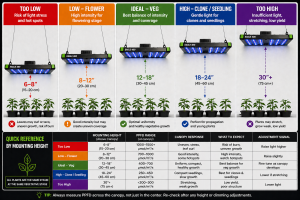
Even a good DLI target can fail in practice if the layout creates poor canopy distribution. Uneven spacing, bad overlap, edge losses, or incorrect mounting height can cause one part of the bench or rack to receive a very different daily total than another. That means DLI planning should never be separated from light uniformity and physical room geometry.
Growers planning multi-level environments should pay special attention to coverage strategy, fixture profile, and rack spacing. The broader LED grow lights collection and the full grow lights, racks, and benches section can help align fixture choices with real cultivation layouts instead of theoretical footprints.
Uniformity Protects DLI Planning Results
If average DLI looks acceptable but the canopy is highly uneven, growers may still see inconsistent development, weak edge performance, and variable crop timing. Good planning is not just about reaching a number. It is about delivering that number consistently across the productive area.
4. Use Dimming and Scheduling to Fine-Tune DLI Planning
One of the best aspects of modern LED systems is the ability to refine output over time. Instead of running every zone at fixed intensity every day, growers can use dimming and schedule-based control to keep DLI planning aligned with crop stage, climate conditions, and operational goals.
When Dimming Improves Daily Light Strategy
Dimming can help when:
- Young plants need a softer start
- Different zones are at different crop stages
- Seasonal temperature shifts affect room management
- Growers want to reduce unnecessary energy use
- Canopy density changes during production cycles
Rather than overbuilding intensity and leaving it static, controllable systems let growers shape total daily photon delivery more precisely. This usually leads to better consistency and fewer avoidable lighting mistakes.
5. Consider Spectrum Strategy During DLI Planning
Although DLI is a quantity-based metric, spectrum still matters. Two lighting systems might deliver a similar daily total, but plant response can differ depending on spectral distribution, crop type, and growth objective. That is why advanced DLI planning should not ignore spectrum strategy.
DLI Planning and Spectrum Tuning
Growers using dual-channel or multi-channel systems may be able to adjust spectral emphasis across crop stages or production goals. This can be useful in facilities where morphology, internode control, rooting behavior, or canopy development is part of the broader cultivation strategy. Spectrum does not replace DLI, but it can work with DLI to support more targeted outcomes.
Growers who are also exploring lower-canopy or supplemental strategies can review ideas at Under Canopy Grow Lighting as part of a broader lighting approach.
6. Recheck DLI Planning After Any Major Room Change
Many lighting plans drift away from their original targets after practical changes are made in the room. Bench reconfiguration, mounting height adjustments, fixture replacements, crop changes, or altered schedules can all affect the actual daily photons delivered to the crop. That is why DLI planning should be reviewed whenever the growing environment changes in a meaningful way.
When to Recalculate DLI Planning
Recalculate or verify DLI after:
- Installing new fixtures
- Changing photoperiod schedules
- Adjusting dimming profiles
- Altering bench or rack spacing
- Moving to a new crop type or cultivar strategy
Growers evaluating both technical performance and project economics may also want to review planning considerations at Grow Lights Rebate, especially when fixture efficiency and long-term upgrade timing are part of the decision process.
Common DLI Planning Mistakes Indoor Growers Should Avoid
Ignoring the Full Day Total
Some growers still evaluate lighting based mainly on peak canopy intensity. That can lead to misleading conclusions if the total daily photons are too low or unnecessarily high.
Using One DLI Target for Every Stage
Different growth phases rarely perform best under the same daily total. Uniform targets across all stages often reduce efficiency and crop precision.
Separating DLI Planning from Layout Design
A good number on paper means very little if poor spacing, bad overlap, or inconsistent mounting height prevent even delivery across the canopy.
How Grow Pros Solutions Supports Better DLI Planning
At Grow Pros Solutions, we focus on practical horticulture lighting solutions that match the real demands of indoor cultivation. That includes fixture profile, efficacy, controllability, canopy coverage, rack compatibility, and production-stage flexibility. The goal is not just to provide more light, but to help growers deliver the right amount of light in a more controlled and repeatable way.
Lighting Solutions for Racks, Benches, and Controlled Environments
Indoor facilities often need lighting systems that fit multi-tier structures, support stable crop development, and allow room for future refinement. A strong DLI strategy should work with the physical environment rather than fight it. That is why layout, fixture selection, and crop planning should always be evaluated together.
Why Better DLI Planning Improves Operational Control
When the room is designed around realistic daily light targets, growers usually gain more control over scheduling, climate coordination, crop uniformity, and energy use. Better planning early on often prevents expensive corrections later.
Final Thoughts on DLI Planning
DLI planning is not just a technical calculation. It is a practical framework for aligning crop needs, fixture output, photoperiod, and room design into one usable strategy. Indoor growers who take DLI seriously are usually in a much better position to improve consistency, avoid waste, and adapt their lighting system as production needs evolve.
If you are designing a new indoor grow room, upgrading a vertical farming system, or refining your existing fixture layout, a stronger DLI strategy can make the whole environment more efficient and more predictable.
If you need help selecting fixtures, planning crop-stage lighting, or building a more effective indoor cultivation layout, contact us for a static and swift result.
FAQ: DLI Planning for Indoor Growers
What is DLI planning in indoor cultivation?
DLI planning is the process of determining how much photosynthetically active light a crop receives each day and aligning lighting strategy with crop stage, photoperiod, and production goals.
Why is DLI planning important for indoor growers?
It helps growers balance intensity and photoperiod, avoid wasted energy, and deliver a more appropriate daily light total for the crop.
Is DLI planning the same as PPFD planning?
No. PPFD measures light intensity at a specific moment, while DLI measures the total amount of light delivered across the full day.
Can dimming help with DLI planning?
Yes. Dimming can help growers refine daily light totals, especially when crop stage, climate conditions, or operational goals change over time.
Should DLI planning be updated after changing fixtures?
Yes. Any major change to fixtures, photoperiod, layout, or crop strategy should trigger a DLI review.