
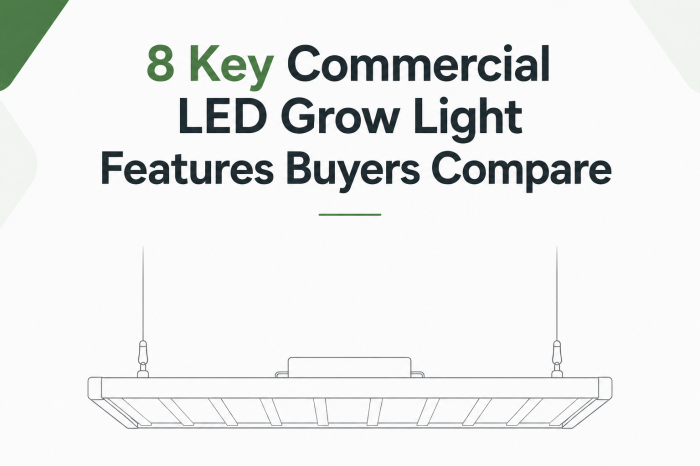

Commercial LED grow lights are not all built the same, even when wattage numbers look similar. Buyers who focus only on output often miss the factors that actually determine canopy performance, energy efficiency, and long-term operating cost. The real difference between systems comes from how light is distributed, controlled, and delivered across the grow space.
Understanding the core features of commercial LED grow lights helps growers avoid common mistakes like over-lighting, poor uniformity, or inefficient layouts. The goal is not just to buy a powerful fixture, but to build a system that performs consistently across the entire canopy.
1. Light Output and PPFD Distribution
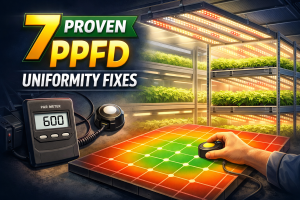
Total output matters, but distribution matters more. A fixture that delivers high PPFD directly under the center but weak edges will create uneven plant growth and inconsistent yield.
This is why PPFD distribution is one of the first things experienced growers evaluate. Even coverage across the canopy is more valuable than peak intensity in a single area.
What to Look For
- Even PPFD spread across full coverage area
- Minimal hot spots under the fixture
- Strong edge performance
2. Spectrum Control and Channel Design
Modern commercial LED grow lights are no longer fixed-spectrum. Multi-channel fixtures allow growers to adjust spectrum depending on growth stage, crop type, and production goals.
Dedicated vegetative setups often rely on vegetative lighting systems that prioritize stable growth structure, while full-cycle fixtures allow spectrum shifts between veg and higher-output stages.
Why It Matters
- Better control over plant morphology
- Improved efficiency across growth stages
- Reduced need to swap fixtures
3. Fixture Efficiency (PPE)
Efficiency, usually measured in micromoles per joule (µmol/J), determines how much usable light is produced per unit of power. Higher PPE means lower operating cost for the same light output.
However, efficiency alone is not enough. A highly efficient fixture with poor distribution can still underperform compared to a slightly less efficient but better-designed system.
Practical Insight
Balance PPE with distribution and layout, not as a standalone metric.
4. Coverage Area vs Real Performance
Manufacturer coverage claims often assume ideal conditions. In real grow rooms, spacing, mounting height, and overlap determine actual performance.
Comparing different commercial LED grow lights shows how fixture layout and design influence real coverage. Broader market fixture format comparisons also highlight how similar wattage fixtures can perform very differently in practice.
Key Takeaway
Do not rely on coverage claims alone. Evaluate how fixtures perform in your specific layout.
5. Mounting Flexibility and Layout Fit
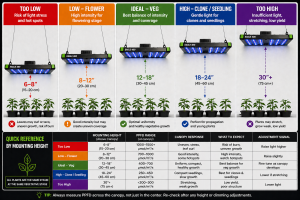
A good fixture is not just powerful—it must fit the space. Mounting height, fixture size, and layout flexibility all affect how well the system integrates into the grow room.
Improper mounting can reduce performance even with a strong fixture. Height, spacing, and layout should be planned together, not independently.
6. Thermal Design and Heat Management
Heat management affects both plant health and system longevity. Poor thermal design can increase canopy temperature, reduce efficiency, and shorten fixture lifespan.
What Good Thermal Design Does
- Maintains stable canopy conditions
- Improves diode lifespan
- Reduces HVAC load
7. Control Systems and Dimming Options
Dimming and control systems allow growers to fine-tune light output without changing fixture position. This is critical for managing DLI planning and adapting to different growth stages.
A flexible control system reduces the need for constant physical adjustments and improves consistency across the grow cycle.
8. Build Quality and Commercial Durability
Commercial environments demand reliability. Fixtures must withstand humidity, long operating hours, and frequent handling.
Important Factors
- Water resistance (IP rating)
- Strong frame construction
- Reliable drivers and components
Durability is not just about lifespan—it affects maintenance cost and system downtime.
Energy Efficiency and System-Level Performance
Efficiency should be evaluated at the system level, not just per fixture. Layout, mounting height, and distribution all affect how much of the produced light is actually used by the canopy.
Better system design reduces wasted photons and improves overall performance, which becomes critical when planning rebate-ready lighting upgrades in commercial facilities.
Supplemental Lighting Considerations
Top lighting drives most canopy performance, but dense crops may require additional support. In these cases, a separate lower-canopy lighting strategy can improve penetration without changing primary fixture layout.
Comparison Table: What Buyers Should Prioritize
| Feature | Why It Matters | Common Mistake |
|---|---|---|
| PPFD Distribution | Ensures even canopy growth | Focusing only on peak output |
| Spectrum Control | Adapts to growth stages | Using fixed spectrum for all stages |
| PPE Efficiency | Reduces energy cost | Ignoring distribution quality |
| Coverage Design | Determines real performance | Trusting marketing specs blindly |
| Mounting Flexibility | Improves layout efficiency | Forcing fixtures into poor layouts |
Final Thoughts on Commercial LED Grow Light Features
Commercial LED grow lights should be evaluated as part of a complete system, not as isolated products. Output, spectrum, efficiency, and layout all work together to determine real performance.
The best results come from balancing these factors rather than maximizing a single metric.
If you need help selecting or designing a system, contact us for a static and swift result.
FAQ: Commercial LED Grow Lights
What is the most important feature in commercial LED grow lights?
PPFD distribution is often more important than peak output because it determines how evenly plants receive light.
Are higher wattage grow lights always better?
No. Distribution, efficiency, and layout matter more than raw wattage.
What is PPE in LED grow lights?
PPE measures efficiency in micromoles per joule and indicates how much usable light is produced per unit of power.
Do I need spectrum control?
Yes. Adjustable spectrum allows better optimization across different growth stages.