
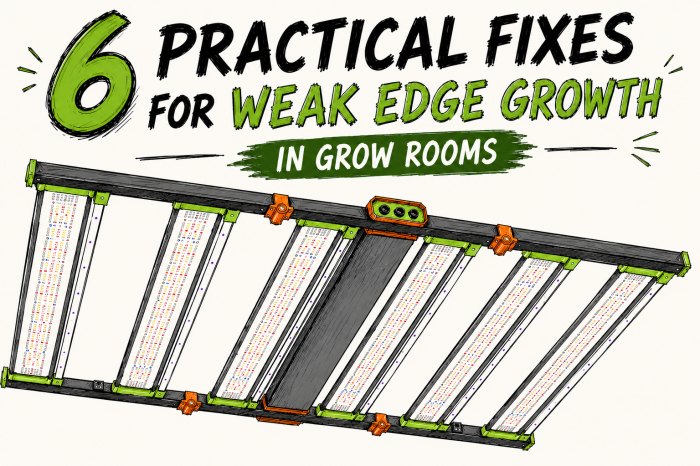


Weak edge growth is one of the clearest signs that a grow room is not distributing light evenly. The center of the canopy may look strong, while the outside rows, corners, and perimeter zones develop more slowly. In high-output rooms, this usually does not mean the strain cannot use more light. It usually means the available light is not reaching the full canopy evenly.
Many strains, herbs, and crops can use higher light levels when CO₂, VPD, temperature, irrigation, nutrition, and canopy health are properly managed. However, that only works when photons are delivered to the right places. If the perimeter is underlit while the center is overpowered, the room is leaving production potential on the table.
Why Weak Edge Growth Happens
Weak edge growth usually comes from uneven canopy light distribution. Fixtures may be centered over the room instead of the productive canopy. Hanging height may concentrate light too tightly. Perimeter rows may receive less overlap than the center. Over time, those small layout problems become visible in plant structure, growth speed, and final crop consistency.
The goal is not simply to make the room brighter. The goal is to make the edge rows receive enough usable light without overdriving the center.
1. Measure the Edges Before Changing Output
The first fix is measurement. Many growers adjust the whole room based on center PPFD, but center readings do not explain weak edge growth. Edge rows, corners, and transition zones between fixtures need their own readings.
A proper canopy check should include:
- Center readings directly under fixtures
- Readings between fixtures
- Left and right perimeter rows
- Front and back canopy edges
- Corner readings
Better PPFD uniformity starts with knowing exactly where the edge drop begins. Without that data, it is easy to increase output in the wrong part of the room.
2. Rework Fixture Spacing Around the Canopy
Weak edges often happen because fixtures are spaced around the room dimensions instead of the crop footprint. Aisles, walls, and service areas do not need the same light level as the productive canopy.
Good fixture spacing should protect the entire growing surface, including perimeter rows. If the layout favors the center, the edge canopy will usually fall behind even when total wattage looks strong on paper.
| Observation | Likely Cause | First Adjustment |
|---|---|---|
| Center strong, edges weak | Poor perimeter coverage | Adjust edge fixture spacing |
| Corners lag behind | Low overlap at boundaries | Measure and correct corner PPFD |
| Outer rows stretch | Insufficient edge intensity | Improve perimeter distribution |
| Center shows stress while edges lag | Fixtures too low or poorly spaced | Raise fixtures and re-map |
3. Adjust Hanging Height to Improve Spread
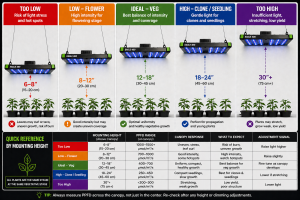
If the light is mounted too low, the center can become too strong while the edge canopy remains weak. Lower fixtures increase intensity, but they also narrow the effective spread. This can make the middle look productive while the perimeter receives less usable light.
Raising fixtures can widen the light pattern and improve edge coverage. However, height should not be changed blindly. After any height adjustment, recheck PPFD across the center, edges, and corners.
Edge problems should be reviewed together with LED grow light hanging height, because height and spacing often solve the same distribution issue from different angles.
4. Avoid Overdriving the Center to Help the Edges
When edge rows are weak, increasing output across the entire room can seem like the easiest fix. In high-output rooms, many strains can use more light when the environment supports it. Still, adding intensity everywhere does not always solve a perimeter problem.
If the center already receives enough light, pushing the whole room harder may increase stress in the strongest zones while the edges still remain behind. The better move is to correct distribution first, then increase output only when the full canopy can use it.
5. Match Fixture Type to the Canopy Shape
Fixture shape affects edge performance. Some fixtures create stronger center intensity, while others spread light more evenly across rectangular benches or repeated rows. A fixture that works well in one footprint may not perform the same way in another layout.
Comparing different commercial LED grow lights helps growers understand how diode layout, frame size, bar spacing, and output pattern affect perimeter coverage. Wider fixture formats often make edge management easier, while concentrated fixtures usually need more careful spacing and hanging height control.
Across the broader market, fixture format comparisons also show why similar wattage numbers can behave differently at the edge of a canopy.
6. Use DLI to Confirm the Edge Is Truly Behind
Instant PPFD readings are important, but weak edge growth is often a daily light problem. A perimeter row may receive less total light across the full photoperiod, even if one quick reading looks acceptable.
That is why edge troubleshooting should include DLI planning. If edge rows receive less daily light for an entire cycle, they will usually show slower development, weaker structure, and less consistent final quality.
When dimming schedules, photoperiods, or fixture output changes, edge DLI should be checked again.
When Lower-Canopy Support Makes Sense
Some edge problems are not only caused by top-light layout. Dense canopies can block light from reaching productive lower sites, especially along the sides of benches or rows. In that case, lowering top lights may create stress without solving penetration.
A separate lower-canopy lighting strategy can support deeper canopy zones while keeping the main top-light layout optimized for upper-canopy distribution.
Edge Growth Troubleshooting Checklist
| Question | Why It Matters |
|---|---|
| Have edge and corner PPFD readings been measured? | Finds weak zones that center readings miss |
| Is the fixture layout based on the canopy footprint? | Prevents light from being wasted outside productive space |
| Are fixtures mounted too low? | Low mounting can create strong centers and weak edges |
| Does DLI vary across the canopy? | Shows whether edge rows receive less total light per day |
| Is dense growth blocking lower sites? | May require supplemental lighting instead of more top-light intensity |
Common Mistakes When Fixing Weak Edge Growth
- Only measuring directly under the fixture
- Increasing output before correcting distribution
- Spacing lights around the room instead of the crop footprint
- Ignoring corner and perimeter rows
- Lowering fixtures when the real issue is poor spread
- Forgetting to recheck DLI after dimming changes
Energy Efficiency and Edge Coverage
Edge performance also affects system efficiency. If light is concentrated in the center while perimeter rows lag behind, the room is not using installed wattage evenly. Better edge coverage helps more produced photons reach productive canopy area.
This matters when planning rebate-ready lighting upgrades, because system performance depends on fixture efficiency, layout, coverage, and usable canopy light—not only the rated output of the fixture.
How GrowPros Solutions Helps Improve Edge Performance
GrowPros Solutions helps growers evaluate lighting as a complete system. Fixture type, spacing, hanging height, dimming, canopy size, and production goals all affect edge performance. In many rooms, a better layout can improve weak edge growth without simply adding more fixtures.
Final Thoughts on Weak Edge Growth
Weak edge growth is usually a light distribution problem, not a crop limitation. High-output rooms can push strong performance when the environment is managed correctly, but the light must reach the full canopy evenly.
Before adding wattage or replacing fixtures, measure the edges, check overlap, review hanging height, and confirm DLI consistency across the crop.
If you need help improving canopy edge performance, contact GrowPros Solutions for a static and swift result.
FAQ: Weak Edge Growth in Grow Rooms
What causes weak edge growth in grow rooms?
Weak edge growth is usually caused by poor perimeter coverage, fixture spacing that favors the center, low edge PPFD, or uneven DLI across the canopy.
Should I add more lights to fix weak edges?
Not always. First check fixture spacing, hanging height, and edge PPFD readings. Better placement may solve the issue before additional fixtures are needed.
Can raising lights improve weak edge growth?
Yes. Raising fixtures can improve spread and overlap, especially when the center is much stronger than the perimeter.
Why are my center rows stronger than the edge rows?
The center often receives more direct and overlapping light. Edge rows may receive less overlap, lower PPFD, or lower daily light exposure.
Does weak edge growth mean the fixture is underpowered?
Not necessarily. The fixture may have enough output, but the layout may not be distributing photons evenly across the full canopy.