
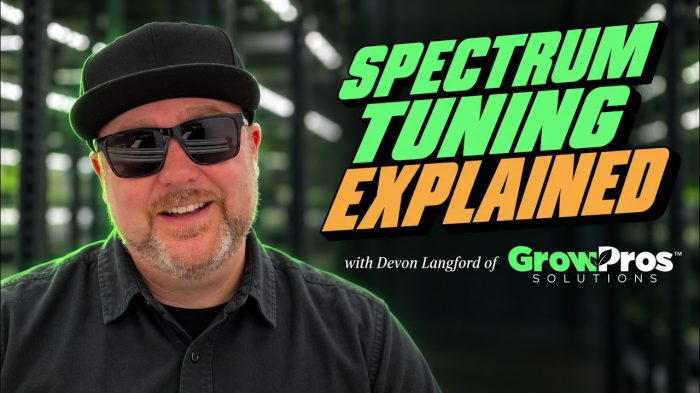

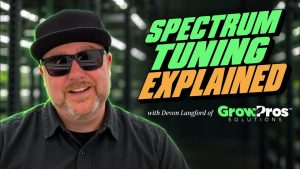
Today’s podcast features Devin Langford from GrowPros Solutions, discussing advanced LED lighting technology, tunable spectrum systems, far-red and UV applications, under-canopy lighting, and high-bay solutions designed to give growers greater control over light intensity, spectrum, coverage, and growing environments.
GrowPros Solutions on the Green Thumb Depot Podcast with Devon Langford
Introduction
Welcome to today’s episode, where we sit down with Devin Langford from GrowPros Solutions, a company focused on advanced LED lighting technology and customizable spectrum solutions for controlled growing environments. Join us as we explore how modern lighting systems are evolving beyond traditional full-spectrum setups and giving growers greater control over light intensity, wavelength, and daily lighting recipes.
From the Emerson effect and far-red lighting to UVA, deep red, and tunable multi-channel fixtures, Devin takes us behind the technology shaping today’s LED lighting systems. We also discuss the GrowPros Chameleon, AK-HB high-bay fixtures, under-canopy lighting, utility rebates, and the importance of matching light intensity with the growing environment. Don’t miss this insightful conversation on spectrum tuning, lighting technology, and the innovations helping growers build more controlled and efficient lighting strategies.


Devon Langford
Director of National Distribution Sales
0:00
Introduction to Devin Langford & GrowPros Solutions
Elliott welcomes Devin Langford of GrowPros Solutions to discuss LED lighting, spectrum tuning, photosynthesis, photomorphogenesis, and how growers can use advanced lighting technology to optimize their growing environments.
1:08
LEDs Went from a Joke to the Standard
Devin and Elliott discuss the evolution of LED lighting from an emerging technology to a mainstream lighting solution, including the growing interest in spectrum control and the differences between LED and HPS lighting.
2:28
Why Full Spectrum Isn’t Enough on Its Own
The conversation explores spectrum tuning and the role of complementary wavelengths, including blue, deep red, far red, and UV, as growers look for more control over plant development and lighting recipes.
3:50
The Emerson Effect
Devin explains the Emerson effect and its connection to far-red and deep-red light, discussing how the concept originated in scientific research and why it has become increasingly relevant to modern LED lighting systems.
4:21
Far-Red Has Two Separate Jobs
The discussion breaks down two different applications for far-red light: combining it with deep red during the lighting period and using it separately at the end of the day as part of a controlled lighting recipe.
4:48
The Sunset Effect
Devin explains how a short period of far-red light at the end of the lighting cycle can create a gradual transition into the dark period and influence photomorphogenic responses.
5:27
Far-Red and Flowering Time
The conversation explores claims around using a short far-red period at the end of the day to influence flowering timing and plant characteristics, while discussing the research and observations behind these lighting practices.
6:46
Emerson Effect vs. Photomorphogenic Signaling
Elliott and Devin distinguish between the Emerson effect, which relates to photosynthetic activity, and photomorphogenic responses, where specific wavelengths can act as signals affecting plant development.
7:42
The Chameleon: Four Channels in One Light
Devin introduces the GrowPros Chameleon, a four-channel lighting platform designed to provide independent control over different spectral ranges and selectable wattage options for different growing requirements.
8:42
UV and Plant Characteristics
The discussion focuses on UV lighting and its potential role in influencing plant coloration, resin, oil, and other natural characteristics, while emphasizing that different growers may have different goals for using UV.
11:05
UVA, UVB & UVC
Elliott and Devin explain the differences between UVA, UVB, and UVC wavelengths and discuss why the different portions of the UV spectrum have different levels of energy and biological impact.
11:33
Why UVA Is the Focus
The conversation examines why UVA has become a greater focus for controlled lighting applications compared with UVB, particularly when discussing plant characteristics and controlled spectrum recipes.
12:12
380 nm UVA
Devin discusses 380 nm UVA as a targeted portion of the spectrum and explains how GrowPros approaches UV as a controlled part of a broader lighting recipe rather than an all-day, full-intensity spectrum.
13:16
UV Results Are Still Being Studied
Elliott and Devin acknowledge that research around UV and plant responses is still developing, with some observations supported by research and others based on grower experience and industry experimentation.
15:13
The White Channel Is the Foundation
Devin explains why the primary white spectrum remains the foundation of the lighting recipe, with blue wavelengths supporting vegetative growth while additional spectral channels provide more specialized control.
15:46
660 nm Deep Red
The discussion covers 660 nm deep red as an important component of the bloom spectrum and explains how it complements the primary white spectrum and works alongside far-red lighting.
16:30
The Daily Lighting Recipe
Devin walks through a dawn-to-dusk lighting approach, describing the use of deep red and far red before the primary white spectrum and a short far-red period after the main lights are turned off.
17:22
When to Use UV
The conversation discusses introducing UV later in the flowering cycle as part of a targeted lighting recipe, with Devin explaining how GrowPros approaches UV intensity and placement within the canopy.
18:46
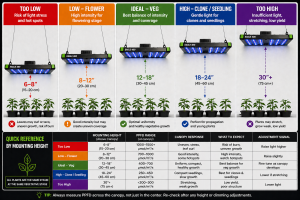
Light Height & Light Distribution
Elliott and Devin discuss the challenges of maintaining proper light height, light distribution, and intensity, comparing bar-style fixtures with higher-mounted LED systems.
19:29
LED vs. HPS
Devin explains GrowPros’ focus on LED technology while acknowledging that HPS lighting can still have applications in certain environments and discussing why growers may choose to standardize around one lighting technology.
20:42
The AK-HB: A High-Bay HPS Replacement
The discussion introduces the GrowPros AK-HB high-bay LED as a potential one-to-one HPS replacement, including its mounting approach, adjustable wattage, light spread, and independent far-red channel.
23:43
Under-Canopy Lighting
Elliott and Devin discuss the growing interest in under-canopy lighting, including its potential to provide additional light throughout the lower portion of the canopy and improve light distribution.
25:00
The Question of Spectrum
The conversation shifts toward spectrum selection, including full-spectrum lighting, red-heavy systems, tunable fixtures, and the ability to independently control UV, deep red, and far-red channels.
28:02
Built from Customer Requests
Devin explains how GrowPros uses customer feedback to guide product development, incorporating features such as airflow, multi-channel spectrum control, waterproof cords, and adaptable mounting solutions.
29:25
Under-Canopy Lighting with Airflow
Devin introduces an under-canopy lighting platform that combines supplemental lighting with airflow, allowing air to move through the system and underneath the canopy.
30:53
The Snake Pattern
Elliott and Devin discuss different under-canopy light layouts, including parallel and crosswise configurations, and how fixture placement can affect light coverage and canopy density.
31:58
Lighting Rebates
The conversation explores utility rebates for LED lighting and explains how rebate availability varies by utility and jurisdiction, with proper documentation and product eligibility playing an important role.
34:28
Checking DLC Eligibility
Elliott cautions that rebate requirements and product listings can change, encouraging customers to verify current eligibility rather than relying solely on older DLC or manufacturer graphics.
35:43
What Causes Plants to Stretch?
Devin and Elliott discuss the relationship between spectrum and plant structure, explaining that excessive far-red can contribute to stretching while insufficient light intensity can have an even greater effect.
36:24
PPFD & Light Intensity
The discussion covers higher-intensity lighting and the importance of monitoring PPFD when increasing light levels, along with adjustments to feeding and environmental conditions that may be needed as intensity rises.
37:06
Light Intensity, VPD & Environment
Devin explains that higher light intensity needs to be considered alongside environmental factors such as CO2, temperature, humidity, feeding, and VPD so plants can effectively respond to increased light levels.
37:44
Closing Remarks
Elliott thanks Devin for sharing his experience with spectrum tuning, LED lighting, and GrowPros technology, closing the episode with a discussion about continued innovation and customer-focused lighting solutions.