
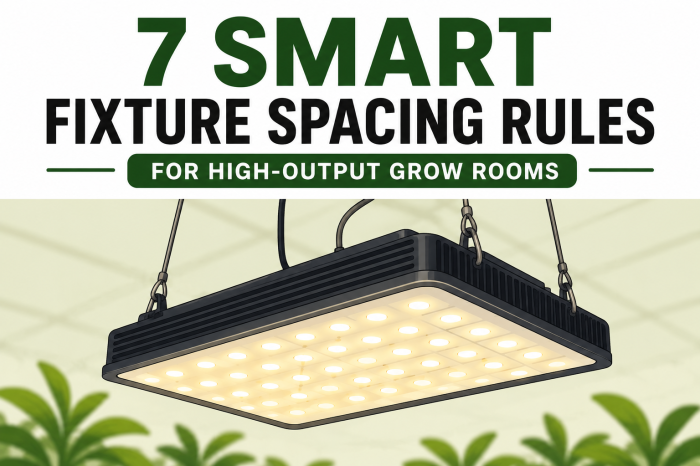

Fixture spacing is one of the most important layout decisions in a high-output grow room. Many growers focus on wattage, spectrum, or fixture efficiency first, but spacing often determines whether that light is actually used by the canopy. A strong lighting system can still create hot spots, weak edges, and uneven crop response if fixtures are placed poorly.
In high-output facilities, many strains can use more light when CO₂, VPD, temperature, irrigation, nutrition, and canopy health are properly managed. The problem is usually not that the room has too much available light. The problem is whether the fixture spacing delivers that light evenly across the canopy instead of creating overlit centers, underlit edges, and wasted photons.
Why Fixture Spacing Matters in High-Output Grow Rooms
Good fixture spacing helps the room use available photons more efficiently. Instead of pushing high PPFD directly under each fixture, the goal is to build a smoother light field across the full productive canopy. That matters because strains, herbs, and crops respond better when the whole canopy receives usable light instead of isolated zones of extreme intensity.
Spacing also affects how well the room works with hanging height, dimming, fixture type, and DLI strategy. If one of those variables changes, the spacing plan may need to be reviewed again.
1. Design Around the Canopy, Not the Room
The first rule of fixture spacing is to design around the productive canopy area, not the full room dimensions. Aisles, walls, service paths, irrigation stations, and equipment zones do not need the same light level as the crop.
When fixtures are spaced according to the room instead of the canopy, photons often spill into non-productive areas while crop edges remain underlit. This creates a room that looks bright but performs unevenly.
Practical Rule
Map the actual canopy footprint first. Then plan fixture spacing around bench width, rack layout, canopy boundaries, and the real growing surface.
2. Use Overlap Without Creating Hot Bands
Some overlap between fixtures is necessary. Without overlap, weak strips appear between lights. However, too much overlap can create hot bands where multiple fixtures over-concentrate photons in the same area.
The best grow light spacing creates a smooth transition between fixtures. The canopy should not have obvious bright lanes and weak lanes. Instead, light should blend evenly from one fixture zone into the next.
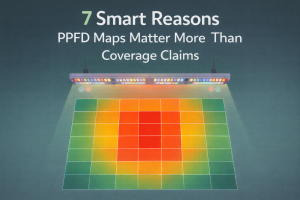
Growers trying to improve overlap should evaluate spacing together with PPFD uniformity, because uniformity is usually the clearest sign that spacing is working correctly.
3. Match Fixture Spacing with Hanging Height
Fixture spacing and hanging height are connected. A fixture mounted higher spreads light farther. A fixture mounted lower concentrates light into a smaller area. That means the same fixture may need different spacing depending on how high it hangs above the canopy.
If lights are mounted too low, spacing usually needs to be tighter to avoid weak gaps. If lights are mounted higher, spacing may be wider, but only if PPFD remains strong enough across the crop.
Before changing the fixture layout, growers should also review LED grow light hanging height. In many rooms, height and spacing solve the same problem from different angles.
4. Strong Center Readings Can Be Misleading
Measuring directly under the fixture is useful, but it does not tell the whole story. A room can show strong center readings while still producing uneven crop development because the edges, corners, and fixture transition zones are weak.
This is why center PPFD should never be the only number used to judge a layout. The best spacing plan protects the entire canopy, not just the brightest point.
| Observation | Likely Spacing Issue | First Adjustment |
|---|---|---|
| Strong center, weak edges | Spacing too wide or poor perimeter coverage | Improve overlap or adjust edge spacing |
| Hot bands under fixtures | Too much overlap or lights too low | Raise fixtures or adjust spacing |
| Weak strips between fixtures | Spacing too wide | Reduce spacing or raise fixtures |
| Good average but uneven crop response | Poor light distribution | Re-map the canopy grid |
5. More Fixtures Do Not Automatically Fix Poor Spacing
Additional fixtures can increase available photons, and many strains can continue using more light when the environment supports it. However, adding fixtures does not automatically improve the canopy if the layout is still uneven.
Poor fixture spacing can cause new fixtures to overlap areas that were already receiving enough light while weaker zones remain under-served. Before adding more power, growers should confirm that existing photons are being delivered to the right places.
In many high-output rooms, better spacing creates a larger improvement than simply adding more fixtures.
6. Treat Fixture Layout as an Energy Strategy
Fixture layout is also an energy decision. A highly efficient fixture can still waste power if photons land in aisles, walls, or already overlit areas. System-level efficiency depends on how much produced light reaches the productive canopy.
Better spacing can reduce wasted photons, improve canopy utilization, and make lighting upgrades easier to justify when planning rebate-ready lighting upgrades for commercial facilities.
7. Dense Canopies May Need a Second Lighting Strategy
Even well-spaced top lighting can struggle when the canopy becomes dense. Upper leaves may block light from reaching productive lower sites, especially in high-output rooms with vigorous strains.
In that situation, forcing the top lights lower is not always the best solution. A separate lower-canopy lighting strategy can support the crop profile while allowing the main top-light layout to stay optimized for upper-canopy distribution.
Commercial Fixture Selection Still Affects Spacing
Fixture spacing starts with fixture design. Diode layout, fixture shape, optics, lensing, frame size, and output pattern all affect how close or far fixtures should be placed from each other.
Comparing different commercial LED grow lights helps show why two fixtures with similar wattage can require different spacing strategies. Broader fixture format comparisons also make it clear that coverage shape can matter just as much as total output.
Fixture Spacing Checklist
| Question | Why It Matters |
|---|---|
| Are fixtures spaced around the canopy, not the room? | Prevents wasted photons outside the crop area |
| Do adjacent fixtures overlap smoothly? | Reduces weak strips and hot bands |
| Are edge and corner readings checked? | Reveals hidden weak zones |
| Does spacing still work after dimming changes? | Keeps light delivery consistent after output adjustments |
| Does fixture spacing match hanging height? | Prevents layout problems caused by height changes |
Common Fixture Spacing Mistakes
- Spacing fixtures by room width instead of canopy width
- Only measuring PPFD directly under fixtures
- Ignoring edge and corner performance
- Adding more fixtures before correcting overlap
- Changing hanging height without rechecking spacing
- Using the same spacing for every crop stage or strain structure
How GrowPros Solutions Helps with Fixture Spacing
GrowPros Solutions helps growers evaluate fixture type, spacing, hanging height, bench width, rack layout, canopy goals, and environmental strategy as one connected system. The best lighting plan is not always the one with the most power. It is the one that delivers usable photons evenly across the canopy with the least waste.
Final Thoughts on Fixture Spacing
Fixture spacing can make the difference between a room that looks bright and a room that performs efficiently. In high-output grow rooms, spacing should be treated as a canopy management tool, not just an installation detail.
Before increasing wattage or adding fixtures, review whether the current layout is delivering photons where the crop can actually use them.
If you need help planning a lighting layout, contact GrowPros Solutions for a static and swift result.
FAQ: Fixture Spacing in High-Output Grow Rooms
How far apart should grow lights be?
The right spacing depends on fixture design, hanging height, output, and canopy size. Start with the active canopy footprint, then adjust spacing based on PPFD mapping and crop response.
Is closer fixture spacing always better?
No. Fixtures that are too close can create excessive overlap, hot bands, and wasted energy. The goal is smooth distribution, not maximum fixture count.
Should fixture spacing change with hanging height?
Yes. Lower lights usually require tighter spacing, while higher lights can spread farther if PPFD remains adequate across the canopy.
Why are the edges of my grow room weaker?
Weak edges usually point to poor perimeter coverage, spacing that is too wide, or insufficient overlap near the boundaries of the canopy.
Can better fixture spacing improve energy efficiency?
Yes. Better spacing reduces wasted photons and helps growers use installed wattage more effectively across the productive canopy.